Tree and Hedge Planting Fertilisers and Soil Fertility
The successful establishment of woody perennials depends on soil fertility, structure, and the localised availability of nutrients during the critical first two growing seasons. Specialist tree fertilisers and hedge fertilisers are designed to reduce transplant shock, stimulate root initiation, and support early-stage development in disturbed or low-fertility soils.
These formulations are particularly important in challenging environments such as new-build landscapes, roadside schemes, and urban planting sites, where soil structure is often compromised. Integrating targeted inputs from a broader soil fertility programme ensures consistent establishment, improved anchorage, and uniform canopy development.
Nutrient Requirements for Woody Plant Establishment
The success of any planting scheme is influenced by the balance of Nitrogen (N), Phosphorus (P), and Potassium (K), alongside secondary nutrients and trace elements.
Phosphorus (P)
Phosphorus plays a key role in early root development as a structural component of ATP, which drives energy transfer within the plant. It is particularly important in low-index soils, where it supports rapid root extension and establishment following planting.
Nitrogen (N)
Nitrogen supports leaf and shoot development once the plant has established a functional root system. Excess nitrogen at planting should be avoided, as it can reduce the root-to-shoot ratio and increase susceptibility to drought stress.
Potassium (K)
Potassium regulates osmotic balance, stomatal function, and enzyme activation. It also contributes to tissue strength and lignification, improving resistance to environmental stress such as wind exposure, frost, and drought.
Many professional fertilisers also include magnesium and trace elements to support chlorophyll production and prevent deficiencies such as interveinal chlorosis during early growth.
Granular, Tablet and Controlled-Release Fertilisers
Modern planting systems utilise a combination of granular fertilisers, slow release fertilisers, and precision delivery formats.
Controlled-Release Fertilisers (CRF)
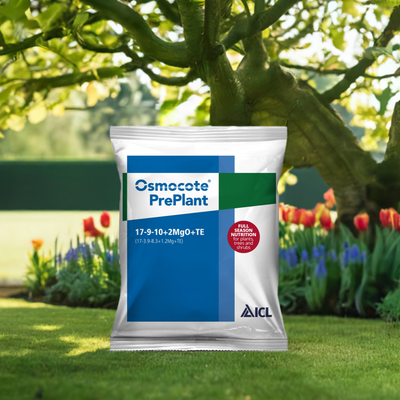
Controlled-release fertilisers use polymer or resin coatings to regulate nutrient release in response to soil temperature and moisture. This ensures a consistent nutrient supply over extended periods while reducing leaching losses.
They are particularly effective for:
- Tree pits and urban planting
- Long-term establishment phases
- Low-maintenance environments
Fertiliser Tablets
Tree fertiliser tablets are widely used in hedge and forestry planting for their precision and ease of application.
Placed directly within the planting hole, or around the root zone they:
- Maximise nutrient availability within the root zone
- Reduce nutrient competition from surrounding vegetation
- Improve consistency across large-scale planting schemes
Granular Fertilisers
Granular fertilisers remain the preferred choice for larger projects and soil incorporation.
They can be lightly worked in to the top few m of soil around plants to:
- Improve overall soil fertility
- Encourage outward root growth
- Reduce the risk of root circling
Soil Structure, Bioavailability and Root Development
Fertiliser performance is closely linked to soil physical condition. In compacted or degraded soils, integrating soil conditioners is essential to improve aeration, drainage, and root penetration.
Healthy soils support:
- Oxygen availability for root respiration
- Microbial activity and nutrient cycling
- Improved water infiltration
The inclusion of wetting agents can be beneficial in free-draining or hydrophobic soils, helping maintain consistent moisture around the root zone and reducing the risk of fertiliser salt stress.
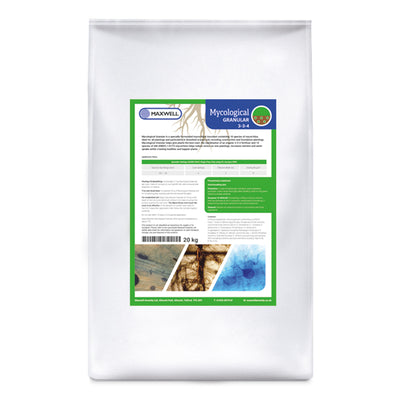
Where appropriate, the use of mycorrhizal fungi can further enhance nutrient uptake by extending the effective root system and improving access to immobile nutrients such as phosphorus.
Integrated Planting and Aftercare Programmes
In professional amenity management, fertilisation is part of a wider integrated strategy designed to protect plant establishment and long-term performance.
Site Preparation
Improving soil structure and nutrient status using conditioners and organic amendments.
Nutrient Application
Applying fertiliser after planting using granular or tablet systems.
Weed Management
Using weed killers & herbicides or mulching materials to minimise competition for nutrients and moisture.
Surface Stabilisation
Establishing surrounding areas with grass seed to reduce erosion and improve site presentation.
Ongoing Maintenance
Applying seasonal top dressings using lawn spreaders to maintain soil fertility across the wider landscape.
Seasonal Timing and Establishment Success
Autumn is widely regarded as the optimal planting season for trees and hedging. Soil temperatures remain relatively warm, allowing for continued root development while above-ground growth is minimal.
Applying fertiliser during this period supports:
- Root system expansion
- Improved establishment before spring
- Enhanced drought resilience in the following season
Explore: autumn fertilisers
Slow-release fertilisers continue to provide nutrition into the growing season, supporting plant stability during periods of environmental stress.
Selecting the Right Fertiliser for Your Site
Fertiliser choice should be based on soil type, planting scale, and maintenance requirements:
- Sandy soils: Benefit from slow-release or repeated low-dose applications
- Clay soils: Hold nutrients well but may require inputs to overcome nutrient lock-up
- Large-scale planting: Tablets or granular fertilisers provide consistency and labour efficiency
- Specimen planting: May benefit from combined granular and biostimulant approaches
Where possible, soil analysis should inform fertiliser selection to ensure nutrients are applied in line with plant demand and existing soil reserves.
Supporting Long-Term Landscape Performance
Investing in high-quality planting fertilisers supports not only initial establishment but the long-term success of trees and hedges within the landscape. By combining targeted nutrition with effective soil management, growers and land managers can ensure the development of resilient, healthy, and structurally sound planting schemes.