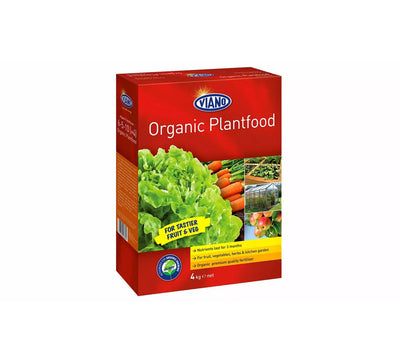
Fruit and Vegetable Fertilisers and Soil Fertility
Achieving consistent, high-quality yields in productive horticulture requires a precise and informed approach to soil fertility. Whether managing allotments, kitchen gardens, or large scale fruit and veg production, the use of specialist fruit and vegetable fertilisers is essential to meet the physiological demands of cropping plants.
Edible crops require targeted nutrient inputs that support flowering, fruiting, and storage organ development. Selecting the correct combination of soil fertility products and fertilisers ensures both immediate plant performance and long-term soil health.
Understanding Soil Fertility and Nutrient Availability
The effectiveness of any fertiliser programme is intrinsically linked to soil structure and chemistry. Soils rich in organic matter exhibit improved Cation Exchange Capacity (CEC), enabling them to retain and exchange key nutrients such as potassium, calcium, and magnesium within the root zone.
This buffering capacity helps regulate nutrient supply, reducing fluctuations that can lead to poor growth consistency. Inadequate nutrient balance—combined with inconsistent moisture—can contribute to physiological disorders such as blossom end rot (linked to disrupted calcium uptake) and fruit splitting.
Incorporating soil improvers and organic amendments plays a critical role in:
- Enhancing nutrient retention
- Supporting beneficial soil microbiology
- Improving drainage and root penetration
The Role of NPK in Crop Growth and Yield
Plant growth is governed by the Law of the Minimum, meaning yield is limited by the most deficient nutrient. The three primary macronutrients—Nitrogen (N), Phosphorus (P), and Potassium (K)—must be managed according to crop type and growth stage.
Nitrogen (N)
Drives vegetative growth and chlorophyll production. Essential for leafy crops such as brassicas and for early-stage development across all fruiting plants.
Phosphorus (P)
A structural component of Adenosine Triphosphate (ATP), phosphorus underpins energy transfer within the plant. It is critical for root establishment, early growth, and flowering initiation.
Potassium (K)
Regulates stomatal function, osmotic balance, and enzyme activation. In fruiting crops, potassium is directly linked to sugar accumulation, fruit quality, and shelf life.
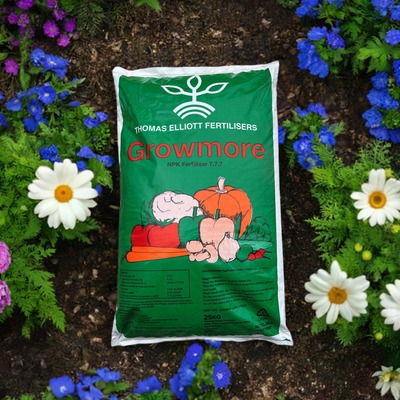
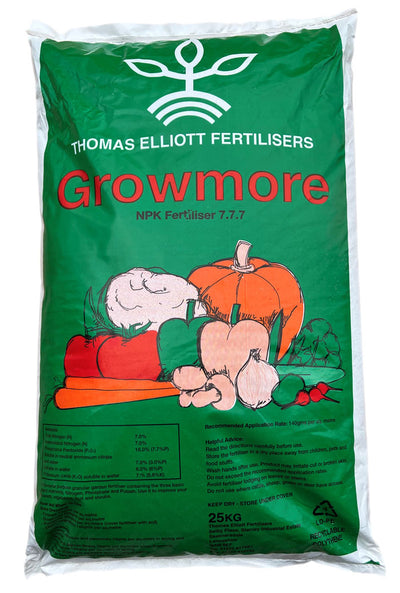
A balanced base fertiliser such as Growmore fertiliser provides a reliable foundation. As crops transition into flowering and fruiting stages, switching to high potassium fertilisers supports improved yield quality and consistency.
Types of Fruit and Vegetable Fertilisers
Different fertiliser formats provide varying release characteristics and agronomic benefits. Selecting the correct type depends on soil condition, crop demand, and timing.
Granular Fertilisers
Granular fertilisers are typically used as a base dressing prior to planting. They provide a stable nutrient reservoir within the soil, releasing nutrients gradually as moisture becomes available.
They are ideal for:
- Pre-season soil preparation
- Incorporation into beds and borders
- Long-lasting nutrient supply
Organic Fertilisers
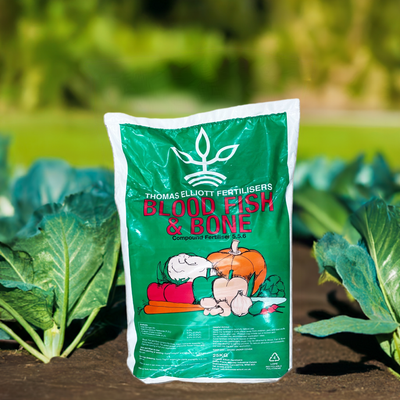
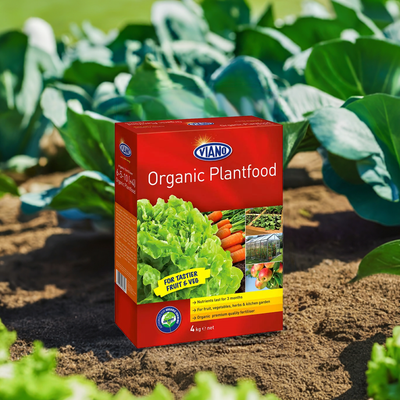
Organic fertilisers such as fish, blood and bone contribute both nutrients and organic matter.
Their benefits include:
- Improving soil structure and humus content
- Supporting microbial activity
- Gradual nutrient release through mineralisation
Organic nitrogen is converted by soil microbes into plant-available forms such as ammonium (NH₄⁺) and nitrate (NO₃⁻), ensuring a sustained nutrient supply.
Liquid Fertilisers and Biostimulants
Liquid & soluble fertilisers and liquid seaweed (NB: Seaweeds without additional nutrients are classed as a biostimulant, but will boost nutrient efficiency) feeds provide rapid nutrient availability.
They are particularly effective:
- During periods of peak demand (e.g. fruit swell)
- Following environmental stress such as drought or frost
- As foliar feeds for quick nutrient uptake
Slow-Release Fertilisers and Nutrient Efficiency
Modern slow release fertilisers are designed to improve Nutrient Use Efficiency (NUE) by releasing nutrients in response to soil temperature and moisture.
This approach:
- Matches plant uptake patterns more closely
- Reduces nutrient leaching
- Minimises environmental impact
Precision feeding is especially important for:
- Light, sandy soils prone to nutrient loss
- High-demand crops such as tomatoes, cucurbits, and peppers
Integrated Fertility Management
In professional amenity horticulture, fertilisation forms part of a wider integrated management system.
A structured approach typically includes:
Soil Preparation
Incorporating organic matter and soil conditioners to optimise structure, drainage, and root development.
Base Fertilisation
Applying granular products using lawn spreaders, hand-held spreaders or by hand to ensure even nutrient distribution.
Targeted Fertilisation
Applying granular products directly around plants to target nutrient availability in a specific area.
Weed Control
Implementing weed control products to minimise nutrient competition and maximise crop uptake.
This integrated approach ensures efficient use of inputs while supporting long-term soil health and productivity.
Seasonal Fertiliser Application
Timing plays a critical role in nutrient effectiveness and crop performance.
Spring
Focus on soil preparation and base fertilisation using products with an NPK ratio that supports early growth and root development in your soil.
Explore: Spring Fertilisers
Summer
Maintain nutrient levels with supplementary feeding, particularly potassium for flowering and fruiting plants and essential micronutrients such as calcium and magnesium.
Explore: Summer Fertilisers
Autumn
Apply organic and slow-release inputs with lower levels of nitrogen to rebuild soil fertility and improve CEC ahead of the next growing season.
Explore: Autumn Fertilisers
Choosing the Right Fertiliser for Your Soil
Soil type significantly influences fertiliser strategy:
- Sandy soils: Low nutrient retention; benefit from frequent applications of slow-release fertilisers and organic matter
- Clay soils: Higher natural fertility but prone to nutrient lock-up; benefit from targeted mineral inputs and structure improvement
Understanding your soil through observation or a soil analysis allows for more precise nutrient management and improved crop outcomes.